

BREAKING NEWS Police Rush to a House After a Serious Incident What the Bodycam Captured Will Send Chills Down Your Spine
COLUMBUS, OHIO — October 12, 2026 — What began as an ordinary call for police assistance quickly developed into a tense and unsettling scene when officers rushed to a residential property following reports of a serious incident. At first, there appeared to be little to distinguish the house from the other homes along the quiet street. The exterior looked familiar, the surrounding neighborhood appeared peaceful, and nothing visible from the road immediately explained why emergency responders had been summoned. But as officers approached the front door, the atmosphere began to change. What happened inside the property, and what the responding officers encountered during their initial investigation, would become the focus of a disturbing sequence of events.
According to the fictional reconstruction presented in this report, the incident took place shortly after emergency dispatchers received a call concerning a possible disturbance inside the home. The caller reportedly sounded worried and provided only limited information, leaving dispatchers with several unanswered questions. Was someone injured? Had an argument turned violent? Was there an immediate danger to the people inside? At that stage, officers had no reliable way to know exactly what awaited them. Their responsibility was to reach the property, assess the situation, and determine whether anyone required urgent assistance.
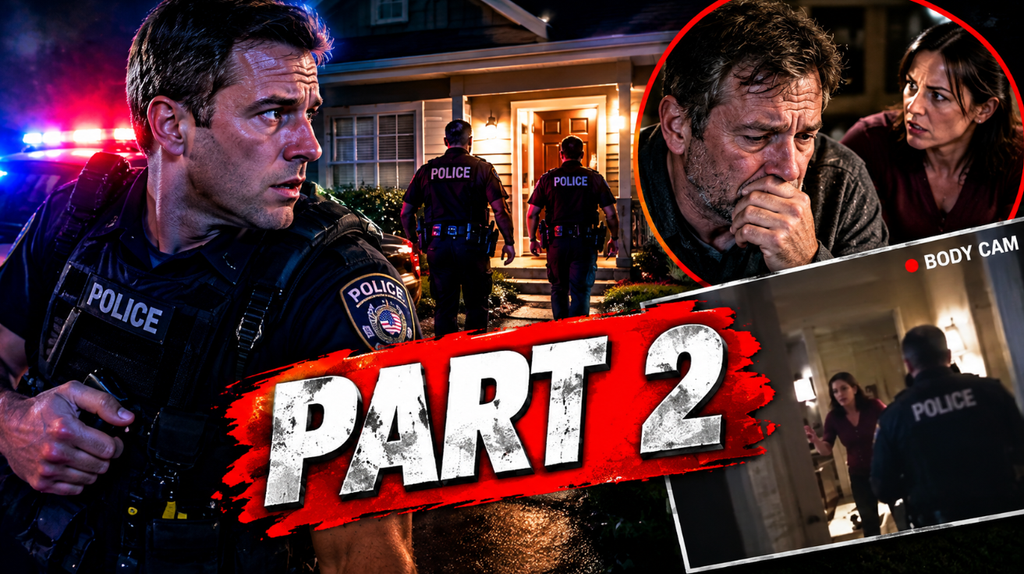
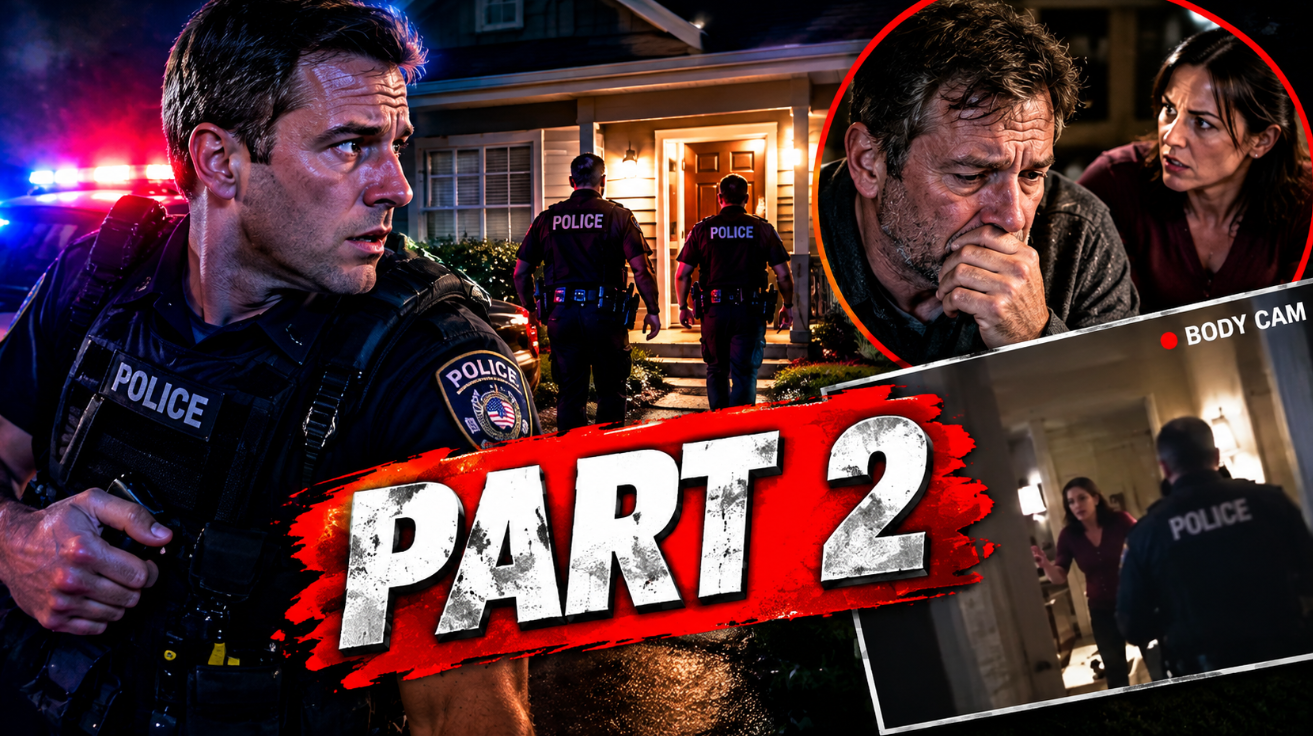
The first patrol vehicle arrived within minutes. Its lights illuminated the front of the house as an officer stepped out and began surveying the property. The officer looked toward the windows, checked the entrance, and listened for any sound that might indicate trouble inside. A second officer arrived shortly afterward, adding another layer of caution to the response. The two officers exchanged brief information before moving toward the entrance. Their body-worn cameras recorded the approach, capturing the officers’ movements, their voices, and the surrounding environment from a perspective that a person watching from the street would never have experienced.
The footage began with the kind of routine details that often accompany an emergency response: footsteps across the walkway, radio communications, the sound of a vehicle door closing, and officers confirming the address. Yet the ordinary nature of these details made the uncertainty more unsettling. The officers had been called to investigate a serious report, but they did not yet know whether the situation involved a medical emergency, a domestic dispute, a criminal act, or a misunderstanding that could be resolved through conversation.
At the front door, the officers attempted to establish contact with the occupants. They announced themselves and waited for a response. For several moments, the situation remained unclear. An officer called out again, listening for movement from inside. The silence did not prove that anything criminal had occurred, but it gave the officers a reason to remain alert while they tried to determine whether anyone inside needed help. They continued communicating with dispatch and coordinating their next steps rather than rushing blindly into an unknown situation.
Then, according to the fictional account, a change inside the house drew the officers’ attention. Their conversation became more focused, and their movements grew more deliberate. One officer remained near the entrance while the other adjusted position to observe the surrounding area. Every decision carried potential consequences. Moving too quickly could increase the danger to an occupant or officer, while waiting too long could delay assistance to someone in need. The officers therefore had to balance urgency with caution, relying on the information available to them rather than assumptions about what might be happening behind the closed door.
When contact was eventually established, the officers began trying to understand who was inside and what had taken place. Their questions were direct but measured. They needed to determine whether everyone was safe, whether anyone had been injured, and whether an immediate threat remained. In situations like this, the first few minutes can be especially difficult because accounts may be incomplete, people may be frightened or confused, and the visible circumstances may not tell the full story. A raised voice, a sudden movement, or an evasive answer can prompt further questions, but none of those details alone establishes that a crime has occurred.
The body-worn cameras added another dimension to the developing investigation. Unlike a distant security camera, a body camera records events from the officer’s own position. It can capture what the officer saw and heard, but it cannot automatically reveal everything happening outside the frame. A camera may record a conversation while missing a movement occurring elsewhere in the room. It may preserve a person’s exact words without explaining the circumstances that led to them. Investigators must therefore consider the footage alongside witness statements, physical evidence, dispatch recordings, and other available information before reaching conclusions.
As the officers continued their assessment, the scene became more complicated. The fictional reconstruction describes an occupant who appeared distressed and another person whose connection to the incident required clarification. The officers worked to separate immediate safety concerns from questions that would need a more detailed investigation. Their first priority was not to determine guilt on the spot, but to establish whether anyone faced an immediate threat and whether emergency medical assistance was necessary.
A central challenge in any serious residential call is the uncertainty surrounding the people involved. A person who appears calm may be concealing fear, while someone who appears agitated may be reacting to shock, confusion, or an entirely different problem. Officers cannot safely assume that a single expression, statement, or gesture explains what has happened. They must ask questions, observe the circumstances, and remain prepared to change their assessment as new information emerges.
The incident also illustrates why communication between responding officers matters. One officer may be focused on speaking with an occupant while another monitors the surrounding area or checks whether additional assistance is required. Radio updates help supervisors understand the situation as it develops. If new information indicates that someone may be injured or that a threat remains, officers can request medical personnel or additional units. The decisions made during these early moments can shape the rest of the response, particularly when the initial emergency call provided only a partial picture of events.
For residents in the surrounding neighborhood, the arrival of police vehicles was likely to raise immediate concerns. Emergency lights, officers moving toward a home, and the possibility of a prolonged police presence can turn an otherwise quiet street into the center of an unsettling event. Neighbors may notice activity without understanding its cause. Some may hear raised voices or see responders entering and leaving the property, while others may know nothing until information begins circulating later. In the absence of confirmed details, speculation can spread faster than reliable information.
That is one reason investigators generally avoid releasing conclusions before the facts have been established. Early reports can be incomplete, and information supplied by a caller may differ from what officers discover after arriving. Witnesses may remember events differently, and the first account of an incident may change as additional evidence becomes available. A responsible investigation must distinguish between what has been directly observed, what someone has reported, and what remains unconfirmed.
The body-camera footage, if available as evidence in a real case, could help investigators reconstruct the officers’ response in chronological order. They could review the time of arrival, the first attempts to contact the occupants, the statements made at the scene, and any visible injuries or signs of damage. They could also compare the recording with dispatch logs and statements from people who were present. The footage might answer important questions, but it could also leave gaps that require further investigation.
One of the most important questions would be what prompted the original emergency call. Was the caller describing something witnessed firsthand, repeating information received from another person, or reacting to sounds that could have had more than one explanation? Establishing the origin of the report would help investigators understand what the officers were told before arriving and whether the initial information accurately reflected the circumstances they encountered.
Another key question would concern the timeline. Investigators would need to establish when the incident began, when emergency services were contacted, how long it took officers to arrive, and what happened before the cameras began recording the encounter. Even a detailed body-camera recording generally captures only a portion of the larger event. It cannot, by itself, provide a complete history of everything that happened before officers reached the property.
The identities and roles of the people involved would also require careful verification. In this fictional reconstruction, the individuals are described as Daniel Whitaker, 61, and Robert Hayes, 57, while Sergeant Michael Reynolds and Officer Emily Carter are used as fictional examples of responding personnel. These names are illustrative rather than verified identities connected to an actual police incident. In a real investigation, officials would need to confirm each person’s identity and clarify whether they were a caller, a witness, an occupant, a person requiring assistance, or someone suspected of wrongdoing.
For investigators, those distinctions are essential. Being present at the scene does not automatically make someone a suspect, and being questioned by police does not establish guilt. The purpose of an initial response is to determine what has occurred and whether further action is necessary. Any later decision to make an arrest or file charges must be supported by the applicable legal standards and evidence, not simply by the dramatic nature of the encounter.
The officers’ actions would also be subject to review if concerns arose about how the incident was handled. Supervisors might examine whether the officers followed department procedures, communicated appropriately, requested medical help when necessary, and used any authority in a lawful and proportionate manner. Body-camera footage can be important in such reviews because it may preserve details that are difficult to recall accurately days or weeks later. However, a fair assessment requires context. A brief clip taken out of sequence can create a misleading impression of an encounter that unfolded over a longer period.
For the public, the most dramatic moments are often the easiest to remember. A sudden command, a tense exchange, or a rapid change in the officers’ behavior can dominate online discussions. Yet those moments may not explain why the officers acted as they did. The preceding conversation, the information available at the time, and the safety concerns facing everyone at the scene may be equally important. Responsible reporting must resist the temptation to treat every tense moment as proof of wrongdoing or every police action as automatically justified.
The incident also raises broader questions about emergency calls involving private homes. Officers frequently arrive without knowing whether they are dealing with a medical crisis, a dispute between family members, a welfare concern, or a possible criminal offense. They must make decisions quickly while remaining aware that the people inside may be frightened, injured, angry, or unwilling to cooperate. Their actions can have serious consequences, making clear communication, careful observation, and appropriate oversight especially important.
For the people directly involved, the consequences may continue long after the emergency vehicles leave. An occupant who required medical attention may face a difficult recovery. A witness may be asked to provide additional statements. Family members or neighbors may struggle to understand what happened, particularly if investigators cannot immediately release information. If a criminal investigation follows, those involved may have to navigate interviews, evidence reviews, court proceedings, and the uncertainty that accompanies a case that has not yet been resolved.
The effect on a neighborhood can also linger. Residents may wonder whether the danger has passed, whether someone has been arrested, or whether they should expect further police activity. Rumors can make an already distressing situation worse, especially when people share unverified claims on social media. Officials and journalists can help reduce confusion by clearly identifying what has been confirmed, what remains under investigation, and what cannot yet be disclosed.
Ultimately, the most significant part of a body-camera recording may not be the moment that appears most dramatic on screen. It may be a brief statement that establishes a timeline, an observation that prompts investigators to ask a new question, or a detail that contradicts an early account. Such evidence can help clarify what happened, but only when examined carefully and in combination with other reliable information.
As this fictional account demonstrates, an emergency call can bring officers to a property before anyone has a complete understanding of the situation. Their arrival may be the beginning of the investigation rather than the end of the mystery. The camera can preserve the encounter, but it cannot replace a thorough examination of the facts. Until the evidence is assessed, the reasons for the call, the actions of the people involved, and the full sequence of events must remain questions rather than conclusions.
For now, the central lesson is clear: a dramatic police response does not, by itself, tell the whole story. What appears straightforward from the outside may be far more complicated once investigators begin examining the details. The most reliable answers come not from speculation or a few seconds of compelling footage, but from verified evidence, careful interviews, transparent procedures, and a willingness to distinguish what is known from what is still uncertain.